Posts

New Media Evolves to Radio

Mark Frauenfelder has a captive print and online audience most journalists would envy. But he’s not stopping there. He joins thousands of hosts and hundreds of thousands of listeners who have discovered BlogTalkRadio’s free talk show service when he appears tonight on The Alan Levy Show to discuss his upcoming book release. Levy is the founder and CEO of BlogTalkRadio . To call in to the show and speak with Alan or Mark, dial +1 (347) 677-0649. Listen live at 9 pm EST tonight or download the show from the archive after it airs. This marks a turning point in broadcast media. Blogtalkradio is empowering citizens worldwide to reach a greater audience and engage a two-way conversation – live. Frauenfelder is founder and co-editor of the Internet's most popular blog BoingBoing ( www.boingboing.net ) which boasts 350,000 readers each month and 1 million subscribers. Frauenfelder is also editor-in-chief of MAKE ( www.makezine.com ) and contributing editor to Wired.com, Madprofessor.n...

Innovation Journalism Conference May 21-23, 2007

Image
Last night I met with one of my favorite people in the industry, humble ex-physicist David Nordfors, now running the Innovation Journalism department at Stanford University. Next week marks his 4th conference on journalism here in the Bay Area. Keynoted first by Doug Engelbart, who I saw many years ago at Parc, and is speaking here about the societal collective intelligence of society, will be moderated by John Markoff. Next, by Curtis Carlson, on the discipline of innovation (insert whip sound here). Mr Carlson is the president of SRI International. Check out the rest of the speakers here , you'll even find some familiar locals. Mr. Nordfors, a best practice communication advocate aiming consistently for a program which will allow us to get more out of the event, is changing the format of this years conference slightly by extending the length of breaks and lunches. This way people can connect, which is the whole idea in the first place. As David left our meeting last night to see ...

A thorn in the nice, fluffy cloud

At Netscape in 1999, I recall entering into the office one morning and being approached by reporters asking if I knew about the email scandal between the company and its competitor Microsoft. Having been briefed by a diligent human resources group, I had no comment but was well aware of its happening and the wave of damage control, present and future, it created through our organization. I think I can say that, generally speaking, can't I? Perhaps more important than the legislation which followed that event was a lesson far greater. The Web offers vast opportunities, really, it's quite fantastic. But it's rapid growth and non-standardized services are more akin to a pool of pirahnas than the relatively slow-moving frontiers we previously conquered in print, radio or TV. Regulations are enforced by priority of the greatest threat, not based on wrongdoing. The whole Internet is a unsupervised free-for-all, where the bullies and the thiefs experience virtual nirvana. There ar...

Participatory Media Supported

Image
Many years ago I worked for a small multimedia company and one of our clients was Macromedia. We wrote documentation for Director 1.0, built interactive help and held trainings around the Bay Area. In my spare time, I used the software to put together a multimedia story for a family member celebrated an 80th birthday, splicing together music, pictures and narration. Sixty people gathered in a local restaurant and watched, it was very sweet. Today, most podcasters, videobloggers, journalists turned new media (and vice versa) are keen on organizations that are supporting participatory media even though there seems to be a good deal of negative press scrutinizing the business model, quality and even safety. But that's not stopping people who have to tell stories, news to share, and feelings and creativity to express. Here are three examples of people putting in the time, helping to make media higher quality and even getting paid. 1) Dan Gillmor, who I wrote about in my last post, and ...

"Messy and wonderful"

That is how Dan Gillmor charactizes the state of Citizen Media tonight at the Mid-Peninsula Community Media Center . The long-time blogger and ex-columnist for the San Jose Mercury News now runs the Center for Citizen Media . Dan touched on the history of the newspaper industry as an example of the changing landscape of journalism and said that for the past 40 years it has been dependent on monopolization. "It was previously bad business to annoy half of your audience." But the traditional journalism business models are quickly eroding. The product is no longer printed on presses that cost $50-75 million. The competition that previously existed in journalism is much less significant today than the present race for ad dollars. We are struggling to encourage local coverage, which is playing a very important role in the value of community knowledge. Investigative and in-depth reporting sites and those adding value to content like newassignment.net , Witness.org , and dotSUB.co...

Captology: A pair of shoes or a cell phone?

Image
I heard a story recently of someone traveling to a poverty-stricken area of the world who said "they didn't have shoes, but they had mobile phones." As pervasive ownership is becoming evident, a question is begged. How will devices like cell phones can change the way we think? When Justin Oberman of Rave Wireless and MoPocket.com calls himself a mobile evangelist, a humorous picture of a man dancing in a mobile phone costume in the mall comes to mind. But Mr. Oberman has some serious views on the use of the ever-growing platform. Here's Justin (and thank you kindly for the interview ) with Jeff Schwartz of Disruptive Strategies at Stanford University’s Mobile Persuasion last month. Stanford University has begun to examine a field of study, called "captology", in their Persuasive Technology Lab, to identify positive persuasive technologies in the areas of health, business safety and education. From the Stanford University Web site, here is a captology dia...

Media in Italy

Image
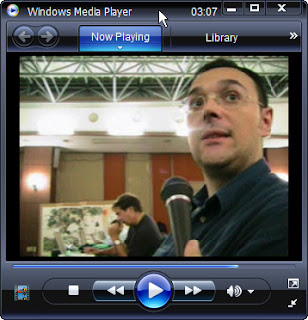
Click to view this 4-minute video Roberto Spiezio, citizen journalst from Italy, is interviewed about his entry into the world of journalism. After my interview with Mr. Spiezio in South Korea, we corresponded by email and he was kind enough to offer more information about politics and media in his home country of Italy. LP: Thank you in advance for your perspectives on life in Italy, Roberto. First, let me ask, how does Italy view immigration? RS: This is a really sensitive issue and one of the usual battlefields for the political parties. The left wing has a policy of aperture about immigration, because of ideological matters and because immigrants are a good source of political consensus. At the moment the government (left wing) has given many immigrants a resident status, as long as they have a regular job. In the past few years the right wing government had cracked down on immigration, by making the entrance and the staying in Italy a lot more difficult. As example, a...