Posts

Why don't we pay for connectivity in rural communities?

The Tech Policy Summit in Silicon Valley begins today examining the individual, corporate and government influence and responsibility in establishing policies online. Walt Mossberg currently interviewing James Cicconi asks "Why does the United States suck at bandwidth?" This question, taking a look at the availability, variety and quality of connectivity. Cicconi responds that some of the problem will be helped when competition increases speed. When asked by a member of the audience whether AT&T might charge those in densely populated area more, in order to support connectivity into rural areas, Cicconi said that "Regulators frown upon this". I would like to know why. Is it because they (we, as consumers, and subsequently carriers) fear customer attrition? Where does the responsibility fall, to the individual, the carriers, the FCC or legislators in Washington DC (who, mentioned this morning by U.S. House of Representatives Congressman Howard Berman, are still c...

Nanotechnology research

Dr. Robert Sinclair was honored with a symposium at Stanford University last week, to celebrate thirty years in the Department of Materials Science and Engineering at the university. The list of symposium speakers, comprised mainly of former students, demonstrates the impact that Professor Sinclair has had on the field of electron microscopy: James Wittig – Vanderbilt University Gary Michal – Case Western Reserve Mary Kay Hibbs-Brenner – VIXAR Fernando Ponce – Arizona State University Alan Pelton – NDCUS Velimir Radmilovic – National Center for Electron Microscopy Martha Mecartney – University of California Irvine Edward Goo – University of Southern California Tom Yamashita – Komag Alan Schwartzman – Massachusetts Institute of Technology Warren MoberlyChan – Lawrence Livermore National Laboratory Thomas Nolan – Seagate Technology Gerardo Bertero – Komag Toyohiko Konno – Tohoku University Subhash Shinde – Sandia National Laboratory Brian Morfitt – Frazier Heath Care Katherine Walker – ...

The Cost of Security

Image
From the RSA Conference in San Francisco, CA, Chief Security Executive, Greg Hughes , discusses how fraudulent criminals go about stealing your identity and the value of Corillian’s products. Coincidentally, just after the interview I learned that Corillian was purchased by CheckFree for $254M. From the press release, today: "Corillian and CheckFree have the potential to accelerate the delivery of future generations of online banking technologies for the industry," said Alex Hart, Corillian President and Chief Executive Officer. "Our organizations and cultures are similar in our mutual commitment to deliver high-value solutions that are flexible, scalable and secure to enhance the financial services websites for our customers and their end users." Corillian supports more than 30 of the top 100 U.S. banks and 21 of the top 100 U.S. credit unions with its online financial services strategy. CheckFree processes more than one billion transactions annually and distribute...

What is the ITU anyway?

Image
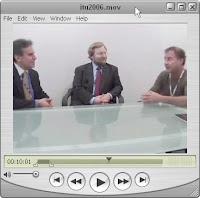
In December 2006, the International Telecommunications Union held its conference in bustling Hong Kong, China . Jeff Schwartz of Disruptive Strategies sat down with long-time organizers of the event, Neustar Managing Director Reza Jafari and CTO Mark Foster , to learn about the event and its purpose.

ITU Conference

Image
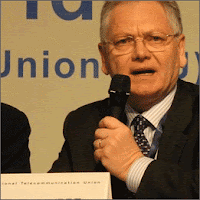
This week I attend the largest technology conference I have seen to date. Typically held in Geneva, the International Telecommunication Union Conference (ITU) was held in Hong Kong December 2006. Held once every 4 years, this event has drawn over 150,000 attendees from all over the world. Those who know me will understand the sheer nirvana I am experiencing in connecting with people from so many countries all discussing and understand opportunities to extend technology and improve social conditions. Very few people I spoke with in the US before the event even knew what the ITU was, including me, so I learned that the ITU is the telecommunications committee for the United Nations (UN). This morning, among a diverse and experienced group of telecommunication leaders in a panel on this first official day of the event, were Andre Smit of Cisco and Didier Philippe , President of the Micro-Enterprise Acceleration Institute in Switzerland, who is working with HP. They spoke about the conver...

"Mashery" out of stealth mode

Mashery made headlines last week at Web 2.0, not by presenting but by being present. http://sfgate.com/cgi-bin/blogs/sfgate/detail?blogid=19&entry_id=10700 Mashery launches with two versions of it's service, "free" and "pro". The free version offers a place online for people to find a company's API, along with documentation and peer support. Also cool, this version includes an integrated forum, wiki, and blog (and you only need one login). The pro account, which typically runs around $1000/month, includes extensive metrics (such as precisely who is using the API and how much), issuing of developer keys, security features and server load protection. You can, however, sign up developers for your community with the free version. I think this service has so very much potential in aiding companies in being successful, in fact, if it had been around in 2000 I bet there would be fewer professionals returning to the Midwest waning "I used to be in that th...

DowJones VentureWire Panel on Web Services

When asked about the latest trends of hosted office applications and how they are built, Marco Boerries (SVP Connected Life, Yahoo!) said at the DowJones VentureWire Consumer Technology Ventures Conference ( pics ) this morning that he did not think it mattered whether these were built in AJAX or Java, what was important was the “openness” of these services. For the office, things like open document formats and rich text editors would continually grow in importance whereas consumers will be mostly about getting media and being able to open it. His response to a question from the audience about open source applications and their future was tepid. Boerries feels that the value chain created by companies such as Microsoft, Intel and Dell is a huge inertia to overcome but the fact is that we do use fewer Windows applications than we did 10 years ago and he looks forward to more Linux-based solutions. “Less time in front of the PC, more time in front of the phone,” says Boerries. Time that...